Sponsored by AI-RMF® LLC
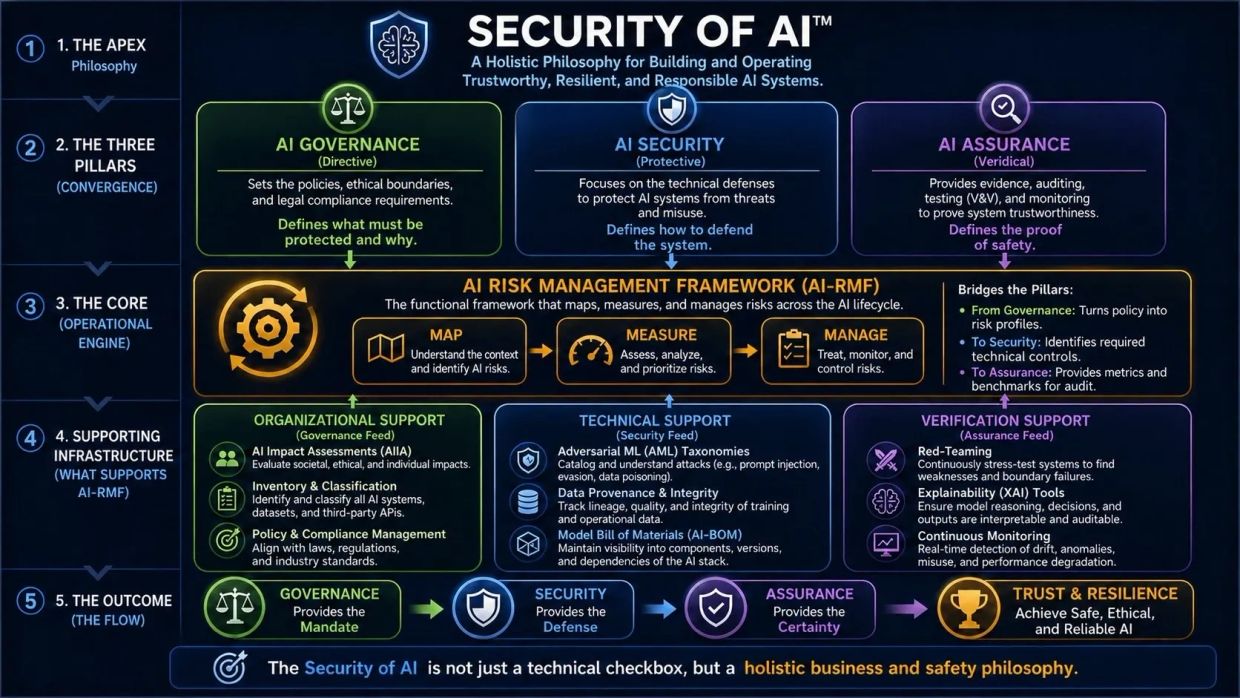
Security of AI™ Framework Description:
The Security of AI™ Framework is organized into five connected layers that move from philosophy to operational outcome. Together, these layers show how organizations can govern, secure, assess, and continuously improve AI systems throughout their lifecycle.
The Apex — Philosophy
The top layer establishes the overarching Security of AI™ philosophy: building and operating AI systems that are trustworthy, resilient, and responsible. It provides the strategic foundation for the entire framework.
The Three Pillars — Convergence
The second layer brings together the three core pillars:
AI Governance defines what must be protected and why.
AI Security defines how the system is defended.
AI Assurance provides the evidence needed to demonstrate that the system is operating as intended.
These pillars are designed to work together rather than as separate disciplines.
The Core — Operational Engine
At the center is the AI Risk Management Framework (AI-RMF), which serves as the operational engine of the model. Through the functions of Map, Measure, and Manage, organizations identify AI risks, assess and prioritize those risks, apply controls, and monitor risk across the AI lifecycle.
Supporting Infrastructure — What Supports AI-RMF
The fourth layer provides the organizational, technical, and verification capabilities needed to make AI risk management effective in practice. These include:
- AI impact assessments
- AI inventory and classification
- Policy and compliance management
- Adversarial machine learning threat analysis
- Data provenance and integrity
- AI Bills of Materials
- Red-team testing
- Explainability tools
- Continuous monitoring
The Outcome — The Flow
The final layer shows how the framework produces its intended result. Governance provides the mandate, Security provides the defense, and Assurance provides the evidence and confidence. Together, these elements lead to the desired outcome: Trust and Resilience — safe, ethical, reliable, and defensible AI systems.
In this structure, Security of AI™ is not simply a cybersecurity model or compliance checklist. It is a five-layer operational philosophy that connects executive direction, governance, technical protection, assurance evidence, and risk management into a unified approach for trustworthy AI.
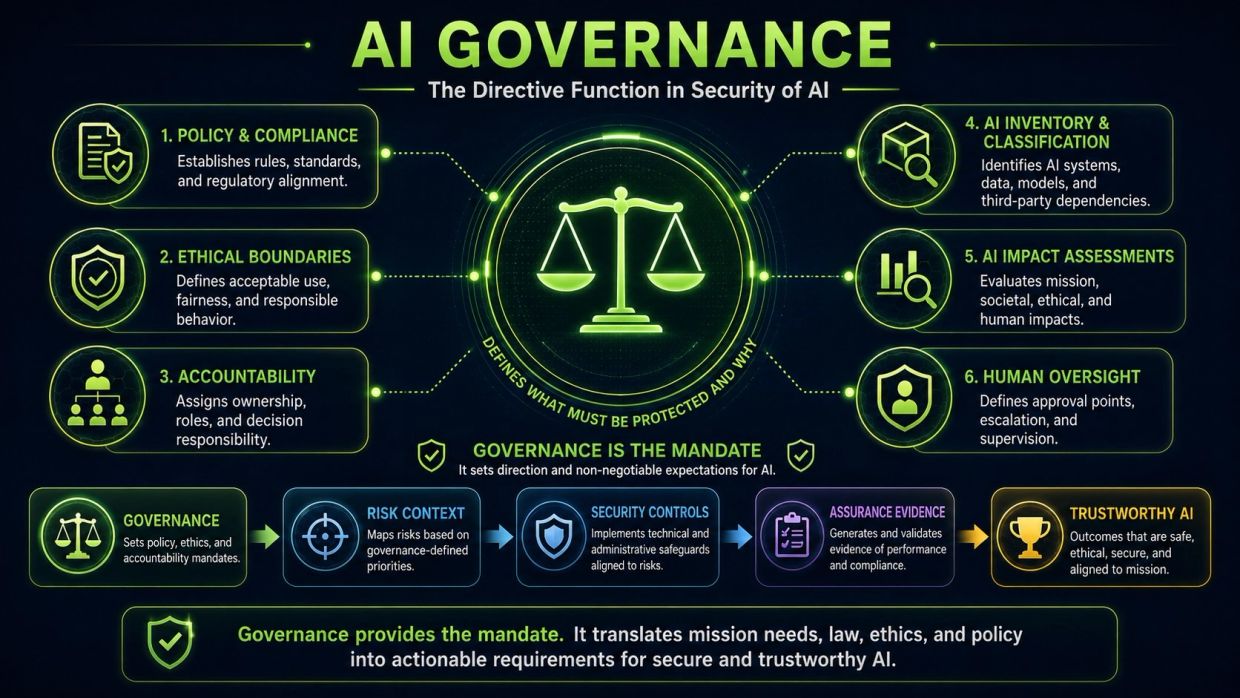
AI Governance as the Directive Function
AI Governance is the controlling, directive function within the broader Security of AI™ philosophy. Governance is not merely paperwork, policy, or compliance administration. In our Security of AI™ model, governance establishes the mandate for how AI systems should be built, deployed, monitored, secured, and trusted.
AI Security can defend systems, and AI Assurance can produce evidence, but governance must first define the mission priorities, ethical expectations, legal requirements, and organizational risk boundaries. Without governance, security controls may be technically impressive but misaligned with the organization’s actual responsibilities. Without governance, assurance evidence may prove that something was tested, but not necessarily that the right risks were addressed.
The Six Governance Functions:
1. Policy & Compliance
The first governance function is Policy & Compliance. This establishes the formal rules, standards, procedures, and regulatory expectations that apply to the AI system.
For Security of AI, this means the organization must define which laws, regulations, standards, internal policies, acquisition rules, cybersecurity requirements, privacy rules, data policies, and mission constraints apply to the AI system. This is where governance turns broad obligations into practical direction.
· Policy and compliance answer questions such as:
· What rules must this AI system follow?
· What standards apply to its development and deployment?
· What regulations or organizational policies constrain its use?
· What must be documented before the system can be trusted?
2. Ethical Boundaries
The second function is Ethical Boundaries. This defines acceptable use, fairness expectations, responsible behavior, and prohibited outcomes.
In Security of AI, ethical boundaries are critical because an AI system can be technically secure but still produce harmful, biased, deceptive, unsafe, or unacceptable outcomes. Governance must define what the organization considers responsible and irresponsible AI behavior.
This includes boundaries around human dignity, fairness, discrimination, manipulation, privacy, transparency, operational safety, and mission appropriateness. It also includes defining when AI should not be used at all.
Ethical boundaries help ensure that AI security is not reduced to cyber defense alone. The system must also be aligned with human values, organizational responsibility, and mission legitimacy.
3. Accountability
The third function is Accountability. This assigns ownership, roles, decision rights, and responsibility.
AI systems often involve many stakeholders: data owners, model developers, system engineers, cybersecurity teams, acquisition officials, program managers, legal advisors, operational users, testers, and senior leaders. Governance defines who is accountable for each part of the AI lifecycle.
Accountability answers questions such as:
· Who owns the AI system?
· Who approves its use?
· Who accepts risk?
· Who monitors performance?
· Who responds when the system fails?
· Who has authority to pause, modify, or retire the system?
This matters because AI risk cannot be managed if responsibility is vague. In Security of AI™, accountability ensures that governance decisions become enforceable actions rather than abstract principles.
4. AI Inventory & Classification
The fourth function is AI Inventory & Classification. This identifies AI systems, data sources, models, interfaces, third-party dependencies, and supporting infrastructure.
An organization cannot govern what it does not know it has. AI inventory is therefore foundational. It provides visibility into where AI exists, what it does, what data it uses, what models it depends on, what tools or APIs support it, and how it connects to other systems.
Classification adds another layer. Not every AI system has the same risk level. Some AI tools may be low-risk administrative assistants. Others may support safety-critical, mission-critical, financial, medical, legal, cybersecurity, or national security decisions.
This function helps determine which AI systems require deeper security controls, stronger assurance evidence, formal testing, human oversight, or executive approval.
5. AI Impact Assessments
The fifth function is AI Impact Assessments. This evaluates mission impact, societal impact, ethical consequences, human impact, and operational risk.
Impact assessments help governance move from general principles to system-specific risk understanding. They ask what could happen if the AI system behaves incorrectly, is attacked, becomes biased, is misused, drifts over time, or produces unreliable outputs.
For Security of AI, this is where governance identifies the potential consequences of AI failure. Those consequences may include mission failure, safety hazards, privacy harm, reputational damage, legal exposure, operational disruption, cybersecurity compromise, or loss of public trust.
AI impact assessments help determine what level of protection, testing, monitoring, and evidence is required.
6. Human Oversight
The sixth function is Human Oversight. This defines approval points, escalation paths, supervision requirements, and human decision authority.
The image emphasizes that governance must determine where humans remain in control. This is especially important for AI systems that support consequential decisions, autonomous functions, cybersecurity actions, operational recommendations, or mission-critical workflows.
Human oversight answers questions such as:
· When must a human approve the AI’s output?
· When can the AI act automatically?
· When must the system escalate uncertainty?
· Who has authority to override the AI?
· What happens when the AI produces conflicting or low-confidence results?
This function prevents automation from silently replacing judgment, accountability, and command authority.
Governance Provides the Mandate
The image includes a central statement: “Governance is the mandate.”
This means governance sets the direction and the non-negotiable expectations for AI. It tells the organization what the AI system is allowed to do, what it must not do, what risks must be controlled, what evidence must be produced, and who is responsible for oversight.
In the Security of AI philosophy, governance is not optional. It is the starting point.
Governance provides the “why” behind security and assurance. It defines the mission, legal, ethical, and organizational priorities that determine which risks matter most.
How Governance Feeds Security and Assurance
Governance → Risk Context → Security Controls → Assurance Evidence → Trustworthy AI
This flow explains how governance becomes operational.
First, governance establishes the policy, ethics, compliance, and accountability mandates.
Second, those mandates shape the risk context. The organization identifies which threats, vulnerabilities, mission impacts, and failure modes matter most.
Third, the risk context drives security controls. These may include access controls, model protection, data provenance, red-team testing, adversarial ML defenses, monitoring, logging, supply-chain controls, and human approval gates.
Fourth, the organization generates assurance evidence. This evidence demonstrates whether the governance requirements and security controls are actually working. Evidence may include test results, audit logs, model evaluations, risk assessments, monitoring reports, validation results, and compliance artifacts.
Finally, the desired outcome is Trustworthy AI: AI systems that are safe, ethical, secure, reliable, accountable, and aligned to mission needs.
Why Governance Matters to Security of AI™
The image above makes an important distinction: AI Governance is not the same as AI Security, but AI Security depends on Governance.
AI Security focuses on defending the system. Governance defines what defense is required, why it matters, and who is responsible for ensuring it happens.
For example, AI Security may implement controls to prevent prompt injection, data poisoning, model theft, unauthorized access, or misuse. But governance determines whether those threats are relevant to the mission, what level of risk is acceptable, what controls are mandatory, and what evidence must be produced to prove readiness.
In that sense, governance is the function that turns AI security from a technical activity into an organizational responsibility.

In the Security of AI™ philosophy, AI Security is the protective function. It is the part of the model that translates governance direction and risk priorities into actual safeguards that defend AI systems from threats, misuse, compromise, and operational failure.
Where AI Governance defines what must be protected and why, AI Security defines how to defend the system.
The Core Meaning of AI Security
AI Security is the discipline of protecting AI systems across their lifecycle.
That includes protection during design, development, training, testing, deployment, operation, monitoring, update, and retirement. It also includes protection against both traditional cyber threats and AI-specific threats.
Traditional cybersecurity asks questions such as:
Can an unauthorized user access the system?
Can an attacker compromise the network?
Can data be stolen, altered, or exposed?
Can the system be disrupted?
AI Security must ask those questions, but it must also go further:
Can the model be manipulated?
Can the training data be poisoned?
Can prompts override intended behavior?
Can sensitive data be extracted from the model?
Can outputs be shaped by adversarial inputs?
Can a third-party model or dependency introduce hidden risk?
Can an AI agent take unsafe actions at runtime?
Can the system drift, degrade, or behave differently after deployment?
That is why AI Security is broader than traditional cybersecurity. It protects not only the infrastructure around the AI system, but also the AI-specific components and behaviors inside the system.
AI Security Provides the Defense
The image’s central message is:
AI Security provides the defense.
This means AI Security implements the technical and administrative safeguards needed to protect AI systems from known, emerging, and mission-relevant threats.
These safeguards may include access controls, encryption, logging, monitoring, data validation, model protection, prompt-injection defenses, adversarial testing, third-party dependency review, runtime anomaly detection, incident response planning, and resilience engineering.
In the Security of AI model, AI Security is not random tool installation. It is not simply buying an AI scanner or adding a firewall. It is a structured protection function that flows from governance and risk.
Governance provides the mandate.
· Risk context identifies the threats and priorities.
· AI Security implements the controls.
· Assurance validates whether those controls work.
· The outcome is trustworthy, resilient, mission-aligned AI.
Function 1: Adversarial ML Defense
The first AI Security function is Adversarial ML Defense.
This function focuses on identifying and countering attacks that are specific to AI and machine learning systems. These include prompt injection, jailbreaks, evasion attacks, data poisoning, model manipulation, model extraction, membership inference, and other adversarial techniques.
For traditional software, the input is usually treated as data to be processed. For AI systems, input can become a behavioral weapon. A carefully crafted prompt, image, document, dataset, or API call may influence the model in ways that bypass intended controls.
Adversarial ML Defense asks:
· How can this AI system be manipulated?
· What inputs could cause unsafe behavior?
· Can the model be tricked into ignoring instructions?
· Can an attacker poison the data pipeline?
· Can the system be made to misclassify, hallucinate, leak information, or take unauthorized action?
This function supports red-team testing, threat modeling, adversarial evaluation, and defensive hardening of AI systems.
Function 2: Data Provenance and Integrity
The second function is Data Provenance and Integrity.
AI systems depend heavily on data. That data may include training data, fine-tuning data, retrieval-augmented generation sources, operational data, sensor data, user prompts, feedback data, and evaluation datasets. If the data is untrusted, corrupted, biased, incomplete, outdated, or manipulated, the AI system may produce unreliable or unsafe results.
Data provenance means understanding where the data came from, how it was collected, how it was labeled, how it was transformed, who had access to it, and whether it has been altered.
Data integrity means ensuring the data remains accurate, protected, traceable, and fit for purpose.
This function asks:
· Where did the data come from?
· Can we prove the data has not been tampered with?
· Is the data suitable for this mission or use case?
· Who labeled or modified the data?
· Are third-party datasets trustworthy?
· Are retrieval sources reliable and current?
· Could poisoned or malicious data enter the AI pipeline?
In Security of AI, data is not merely an input. It is part of the security boundary. Compromised data can become compromised behavior.
Function 3: Access Control and Model Protection
The third function is Access Control and Model Protection.
AI systems contain high-value assets. These may include model weights, training datasets, embeddings, prompts, system instructions, APIs, fine-tuning files, evaluation results, architecture details, and operational logs. If these assets are exposed or manipulated, the AI system can be stolen, replicated, degraded, bypassed, or weaponized.
Access control determines who can use, modify, deploy, retrain, query, export, or administer the AI system.
Model protection focuses specifically on preventing unauthorized access to model internals, model weights, sensitive configurations, and proprietary or mission-sensitive AI components.
This function asks:
· Who can access the model?
· Who can change the system prompt or configuration?
· Who can upload data into the AI pipeline?
· Who can approve model updates?
· Who can call the API?
· Who can retrieve logs or outputs?
· Can the model be extracted or copied?
· Can sensitive information be inferred from model behavior?
This is especially important for enterprise, defense, critical infrastructure, healthcare, financial, and government AI systems where misuse or unauthorized modification could have serious consequences.
Function 4: AI-BOM and Dependency Visibility
The fourth function is AI-BOM and Dependency Visibility.
An AI system is rarely a single model operating in isolation. It is usually an ecosystem of components: foundation models, open-source libraries, APIs, datasets, vector databases, agents, orchestration tools, plugins, cloud services, labeling tools, monitoring systems, and third-party services.
An AI Bill of Materials, or AI-BOM, provides visibility into these components and dependencies.
This matters because hidden dependencies create hidden risk. A system may appear secure at the application layer while relying on an unverified model, vulnerable library, unknown dataset, compromised API, or third-party tool that changes without notice.
AI-BOM and dependency visibility ask:
· What models are being used?
· What datasets support the system?
· What open-source libraries are included?
· What third-party APIs are called?
· What versions are deployed?
· What components are mission-critical?
· Which dependencies are externally controlled?
· What happens if a provider changes, fails, or is compromised?
This function is essential for AI supply-chain security. It gives the organization the ability to understand, manage, and secure the AI stack.
Function 5: Runtime Monitoring
The fifth function is Runtime Monitoring.
AI Security does not end at deployment. In many cases, the most important security events happen after the system is operational.
An AI system can drift. User behavior can change. Attackers can probe it. Data sources can become stale or compromised. Model outputs can degrade. AI agents can take unexpected actions. New vulnerabilities can emerge.
Runtime monitoring detects these issues while the AI system is in operation.
This function asks:
· Is the AI system behaving as expected?
· Are users attempting prompt injection or misuse?
· Are outputs becoming less reliable?
· Is the model drifting from expected performance?
· Are there abnormal query patterns?
· Are agents taking unusual actions?
· Are security-relevant failures increasing?
· Are there signs of data poisoning, model abuse, or unauthorized access?
Runtime monitoring is critical because AI systems are dynamic. A model that was acceptable at deployment may become unsafe or unreliable over time.
Function 6: Incident Response and Resilience
The sixth function is Incident Response and Resilience.
No security model can assume perfect prevention. AI systems will be attacked, misused, misconfigured, degraded, or placed under unexpected operational stress. Therefore, the organization must be prepared to respond.
Incident response defines what happens when something goes wrong.
Resilience defines how the system continues, recovers, or safely degrades when under attack or failure.
This function asks:
· What happens if the AI system is compromised?
· Who is notified?
· Can the system be isolated or shut down?
· Can the organization roll back to a known-good model?
· Can the AI function be transferred to a human process?
· Can corrupted data be removed?
· Can logs support forensic review?
· Can mission operations continue safely?
AI incident response must include more than traditional cyber response. It must account for model behavior, prompt abuse, data poisoning, harmful outputs, agentic actions, and degraded trust in AI-generated decisions.
How AI Security Fits Into the Security of AI Flow
The lower part of the image shows the operating flow:
Governance → Risk Context → Security Controls → Assurance Evidence → Trustworthy AI
This flow is central to understanding AI Security.
Governance provides the mandate. It defines the policy, ethical, legal, mission, and accountability requirements.
Risk context identifies the threats, vulnerabilities, mission impacts, and priorities.
AI Security implements the controls needed to defend the system.
Assurance evidence validates whether those controls are effective.
Trustworthy AI is the desired outcome: AI that is secure, resilient, reliable, ethical, and aligned to mission needs.
This is important because AI Security should not operate in isolation. It should be driven by governance and tested through assurance.
AI Security Is Both Technical and Administrative
The image explains that AI Security implements both technical and administrative safeguards.
Technical safeguards may include:
Access controls, authentication, encryption, monitoring, adversarial testing, secure APIs, logging, data validation, model isolation, sandboxing, rate limiting, anomaly detection, and secure deployment pipelines.
Administrative safeguards may include:
Security policies, approval gates, risk acceptance decisions, roles and responsibilities, model release procedures, supplier review, incident response plans, configuration management, and audit requirements.
Both are necessary.
A technical control without policy may be inconsistent or unenforced.
A policy without technical implementation may be meaningless.
AI Security connects the two.
Why AI Security Is Different from Traditional Cybersecurity
AI Security includes cybersecurity, but it is not limited to cybersecurity.
Traditional cybersecurity protects systems from unauthorized access, disruption, data loss, and compromise. AI Security must also protect against manipulation of model behavior, training data, prompts, outputs, and autonomous actions.
For example, a traditional application may be secure if access is controlled and data is encrypted. But an AI system may still be vulnerable if a user can manipulate the prompt to bypass safety rules, poison a retrieval source, extract sensitive training data, or cause the model to generate harmful instructions.
This means AI Security must defend the system at multiple levels:
· The infrastructure level.
· The application level.
· The data level.
· The model level.
· The prompt and interface level.
· The agentic workflow level.
· The operational mission level.
That is why AI Security must be treated as a distinct function within Security of AI.
AI Assurance as the Veridical Function in SOAI
Assurance Pillar in SOAI:
In the Security of AI™ philosophy, AI Assurance is the function that provides evidence, validation, verification, monitoring, and confidence that an AI system is operating safely, reliably, securely, and in alignment with its intended mission.
Where AI Governance defines what must be protected and why, and AI Security defines how to defend the system, AI Assurance defines how to prove that the system is working as intended.
In plain terms:
Governance provides the mandate. Security provides the defense. Assurance provides the proof.
The Core Meaning of AI Assurance
AI Assurance is the process of developing confidence that an AI system is fit for use, safe enough for its mission context, resistant to known risks, and continuously monitored after deployment.
It answers questions such as:
· Is the AI system doing what it was designed to do?
· Can we prove that it meets requirements?
· Has it been tested against expected and unexpected conditions?
· Has it been red-teamed for misuse, abuse, and boundary failures?
· Are the outputs explainable enough for the intended users?
· Are performance, safety, reliability, robustness, and compliance being measured?
· Is the system still trustworthy after deployment?
This is why the image refers to AI Assurance as the veridical function. “Veridical” means truth-confirming or truth-oriented. AI Assurance is the part of Security of AI that attempts to determine whether the system’s claimed behavior matches its actual behavior.
AI Assurance Provides the Proof
This means AI Assurance turns testing, evidence, audit artifacts, monitoring, and evaluation into decision confidence.
Without assurance, an organization may believe that an AI system is safe, secure, or reliable, but it may not be able to prove it. The system may have strong policy language and technical controls, but without evidence, leadership cannot know whether those controls are effective.
AI Assurance creates the evidence needed to support informed decisions about deployment, continued use, risk acceptance, compliance, and corrective action.
It helps answer a critical leadership question:
Why should we trust this AI system?
Function 1: Validation and Verification
Validation asks whether the AI system is suitable for its intended use. It focuses on whether the system solves the right problem, supports the mission, and performs acceptably in its operational context.
Verification asks whether the system was built correctly against defined requirements. It focuses on whether the system meets specifications, performs as expected, and satisfies documented technical, operational, safety, security, and compliance requirements.
For AI systems, validation and verification are more complex than they are for traditional software because AI behavior may be probabilistic, data-dependent, context-sensitive, and difficult to fully predict.
Validation and verification ask:
· Does the AI system meet its stated requirements?
· Does it perform acceptably under realistic mission conditions?
· Does it fail safely?
· Does it support the intended human decision process?
· Does it behave consistently across relevant data populations and operating conditions?
· Does it remain within its approved use boundaries?
This function is foundational because it establishes whether the AI system is ready for use in the first place.
Function 2: Red-Teaming
Red-teaming stress-tests the AI system to uncover weaknesses, unsafe behavior, boundary failures, misuse pathways, and adversarial vulnerabilities. It is not merely a cybersecurity exercise. In AI Assurance, red-teaming is used to test how the AI system behaves when it is challenged, manipulated, confused, or placed under abnormal conditions.
AI red-teaming may examine prompt injection, jailbreak attempts, data leakage, evasion attacks, harmful output generation, bias amplification, unsafe recommendations, tool misuse, model overconfidence, hallucination, and failure under edge cases.
Red-teaming asks:
· Can the system be manipulated into violating policy?
· Can an attacker bypass safety controls?
· Can the model leak sensitive information?
· Can users cause unintended or unsafe behavior?
· Can the system be tricked by poisoned data, adversarial prompts, or malformed inputs?
· Can an AI agent be induced to take unauthorized actions?
The value of red-teaming is that it tests the system against the uncomfortable reality of hostile, careless, creative, or unexpected use.
Function 3: Audit Evidence
The third function is Audit Evidence.
AI Assurance requires evidence that can be reviewed, traced, explained, and defended. This may include test reports, evaluation results, audit logs, model cards, data documentation, configuration records, risk assessments, monitoring reports, human review records, incident reports, and approval artifacts.
Audit evidence is what allows leadership, oversight bodies, customers, regulators, acquisition officials, or independent reviewers to determine whether the AI system has been governed, secured, tested, and monitored properly.
Audit evidence asks:
· What was tested?
· When was it tested?
· Who performed the test?
· What data was used?
· What requirements were evaluated?
· What were the results?
· What risks remain?
· Who accepted those risks?
· What changed after deployment?
· Can the evidence be independently reviewed?
This function is especially important because AI systems can evolve over time. Evidence must not only show what was true at deployment; it must support continued confidence throughout the lifecycle.
Function 4: Explainability and Interpretability
AI systems often produce outputs that are difficult for users, operators, auditors, or decision-makers to understand. Explainability and interpretability help reveal why the system generated a particular result, what factors influenced the output, and whether the reasoning appears appropriate for the mission context.
Explainability is not required at the same level for every AI system. The level of explanation should depend on the system’s risk, mission impact, autonomy level, and decision consequence.
For low-risk systems, basic transparency may be enough. For high-consequence systems, stronger interpretability may be necessary.
Explainability and interpretability ask:
· Why did the AI system produce this output?
· What data or features influenced the result?
· Can a human understand the basis of the recommendation?
· Are the explanations meaningful or merely decorative?
· Can the system support audit, appeal, review, or correction?
· Can users detect when the AI may be wrong?
This function supports human oversight, accountability, safety, and trust.
Function 5: Evaluation Metrics and Benchmarks
AI Assurance depends on measurement. An organization cannot prove performance, reliability, robustness, fairness, security, or compliance without clear criteria and measurable evidence.
Evaluation metrics and benchmarks define how the system will be judged.
These may include accuracy, precision, recall, false positive rate, false negative rate, latency, robustness, fairness, explainability, calibration, drift, refusal behavior, cybersecurity resilience, mission effectiveness, and compliance performance.
For generative AI, additional metrics may include hallucination rate, citation accuracy, harmful output rate, prompt-injection resistance, tool-use reliability, groundedness, toxicity, privacy leakage, and policy compliance.
Evaluation metrics and benchmarks ask:
· What does acceptable performance mean?
· What thresholds must be met before deployment?
· What conditions must be tested?
· What failure rates are tolerable?
· What safety or security metrics matter most?
· How will performance be measured after deployment?
· What triggers retraining, rollback, review, or removal?
This function helps transform broad trust goals into measurable assurance criteria.
Function 6: Continuous Monitoring
AI Assurance does not end when the system is deployed. In fact, some of the most important assurance work begins after deployment because real-world use exposes the system to changing data, changing users, changing threats, and changing mission conditions.
Continuous monitoring tracks whether the AI system remains trustworthy over time.
It may detect model drift, data drift, performance degradation, abnormal behavior, misuse, adversarial probing, policy violations, excessive hallucination, unexplained output changes, security incidents, or changes in third-party dependencies.
Continuous monitoring asks:
Is the system still performing as expected?
· Has the data changed?
· Has the threat environment changed?
· Are users misusing the system?
· Are outputs becoming less reliable?
· Are failures increasing?
· Are there signs of attack, manipulation, or drift?
· Does the system still meet its approved risk posture?
This function is critical because AI systems are not static. A system that passed testing six months ago may no longer be trustworthy today if the environment, data, model, dependencies, or threat landscape has changed.
How AI Assurance Fits Into the Security of AI Flow
The image shows a lower process flow:
Governance → Security → Assurance Evidence → Decision Confidence → Trustworthy AI
This flow explains how AI Assurance fits into the larger Security of AI philosophy.
Governance provides the mandate. It defines requirements, boundaries, accountability, mission expectations, and acceptable risk.
Security implements the defense. It puts controls in place to protect AI systems from threats, misuse, and operational failure.
Assurance evidence validates performance. It determines whether the system actually meets the requirements and whether the controls are working.
Decision confidence supports trust. Leaders, operators, users, and oversight authorities gain confidence because decisions are based on evidence rather than assumption.
Trustworthy AI is the intended outcome. The goal is an AI system that is safe, reliable, secure, accountable, and aligned to mission needs.
AI Assurance Is Evidence-Based Trust
A central point of the image is that AI Assurance turns trust into something measurable and reviewable.
This matters because AI trust cannot be based on vendor claims, executive optimism, model popularity, benchmark marketing, or the assumption that a system worked during a demonstration.
For Security of AI, trust must be earned through evidence.
That evidence should show that:
· The AI system was tested against requirements.
· Known risks were evaluated.
· Security controls were validated.
· Human oversight was defined.
· Performance was measured.
· Failure modes were examined.
· Outputs were reviewed.
· Monitoring is in place.
· Residual risks are known and accepted.
This is the difference between saying, “We trust the AI,” and being able to say, “Here is the evidence that supports our trust decision.”
Why AI Assurance Matters
AI Assurance matters because AI systems can fail in ways that are difficult to detect, explain, or reproduce.
A traditional software system may fail because of a coding defect, configuration error, or infrastructure problem. AI systems may fail because of poor data, biased training, adversarial manipulation, model drift, hallucination, overconfidence, ambiguous prompts, changing context, or unforeseen interactions with other systems.
AI Assurance helps detect these problems before they cause harm and continues watching for them after deployment.
It also supports accountability. When AI systems are used in meaningful decisions, organizations must be able to explain how those systems were evaluated, what risks were known, what mitigations were applied, and why deployment was approved.
AI Assurance Is Not Just Testing
Testing is part of AI Assurance, but Assurance is broader than testing.
Testing may show how the system performed under selected conditions.
Assurance combines testing with evidence, monitoring, metrics, red-teaming, explainability, auditability, and lifecycle oversight.
A single test result does not prove that an AI system is trustworthy. Assurance requires a body of evidence that grows and changes as the system evolves.
That is why the image emphasizes validation, verification, red-teaming, audit evidence, explainability, benchmarks, and continuous monitoring together. These activities form a practical assurance ecosystem.