Sponsored by AI-RMF® LLC
AI Assurance Intelligence Navigator
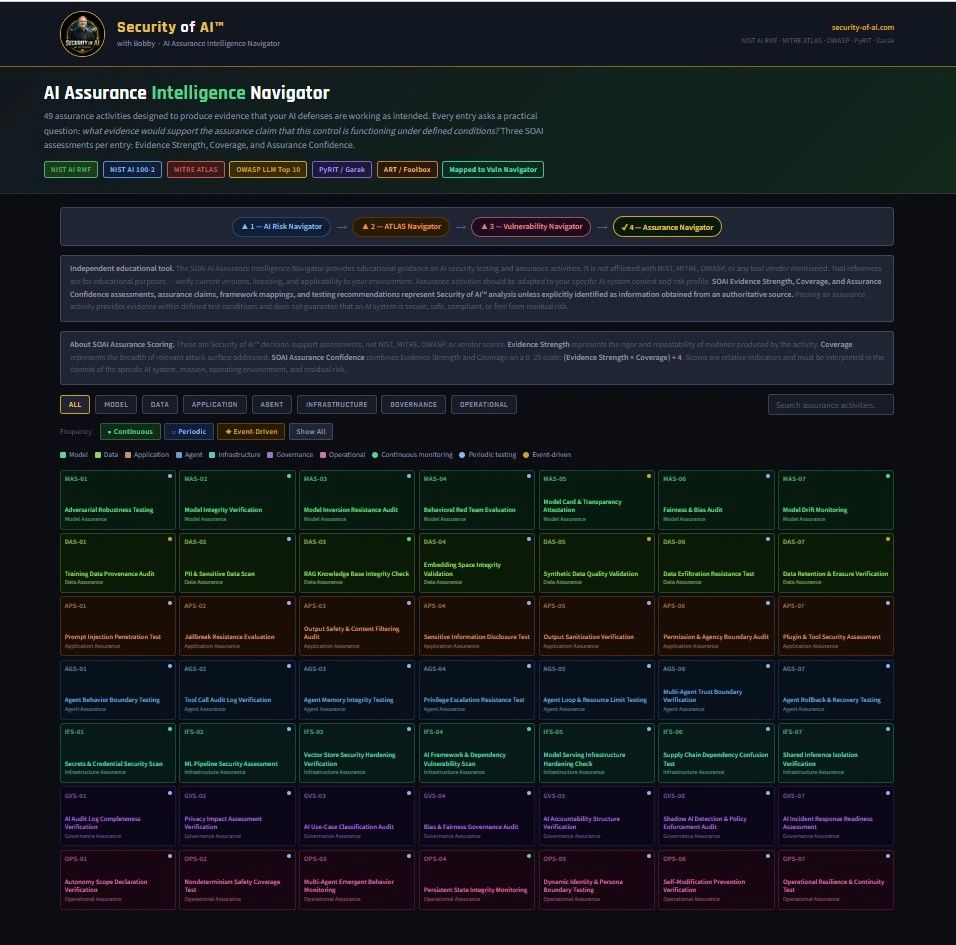
The Security of AI™ AI Assurance Intelligence Navigator is an interactive decision-support tool designed to help users determine what evidence can be used to evaluate whether AI security defenses are working as intended. Identifying risks, threats, vulnerabilities, and mitigations is essential, but those activities leave an important question unanswered:
Description and Instructions:
Important Notice:
The Security of AI™ AI Assurance Intelligence Navigator is an independent educational and decision-support resource.
It is not affiliated with, sponsored by, or endorsed by MITRE, NIST, CISA, OWASP, or other referenced organizations.
CVE, CWE, CISA KEV, MITRE ATLAS™, NIST publications, OWASP resources, and other referenced frameworks remain authoritative at their respective official sources.
Framework mappings, class-level severity estimates, AI amplification estimates, attack scenarios, mitigation guidance, and SOAI risk assessments represent Security of AI™ analysis unless explicitly identified as values or information obtained from an authoritative source.
Instructions:
Additional Information:
AI Assurance Intelligence Navigator: What It Is and How to Use It.
The Security of AI™ AI Assurance Intelligence Navigator is an interactive decision-support tool designed to help users determine what evidence can be used to evaluate whether AI security defenses are working as intended.
Identifying risks, threats, vulnerabilities, and mitigations is essential, but those activities leave an important question unanswered:
What evidence demonstrates that the defenses work?
The AI Assurance Intelligence Navigator helps answer that question by connecting AI security concerns with practical assurance activities, testing methods, evidence, artifacts, and ongoing monitoring.
The Navigator contains 49 assurance activities organized across AI assurance domains including:
- Model
- Data
- Application
- Agent
- Infrastructure
- Governance
- Operational
Each assurance activity begins with a practical assurance question and identifies the evidence that can be produced to support an assurance claim.
The objective is not to declare an AI system “secure” or eliminate uncertainty.
The Navigator provides a Security of AI™ assurance and evidence layerthat helps answer a different question:
What evidence do we have that the controls and defenses are actually working?
Why It Matters
AI security cannot end when a control is implemented.
A model may have adversarial-input protections. An AI agent may have restricted permissions. Sensitive data may have access controls. An application may include prompt-injection defenses.
But implementing a defense does not automatically demonstrate that the defense is effective.
Assurance requires evidence.
That evidence may come from testing, technical measurements, configuration verification, runtime monitoring, audit records, red-team activities, independent evaluation, or other forms of verification.
The AI Assurance Intelligence Navigator helps users examine:
What are we trying to demonstrate?
What testing or evaluation should be performed?
What evidence should be produced?
What artifact should document the results?
How often should the activity be performed?
What vulnerabilities and attack techniques does the activity address?
What frameworks relate to the assurance activity?
How much confidence does the evidence provide?
The goal is to move AI security beyond simply implementing controls toward evidence-based assurance.
How to Use the AI Assurance Intelligence Navigator
Step 1 — Explore the Assurance Activities
Select an assurance activity from the Navigator.
Activities are organized across AI assurance domains including:
- Model
- Data
- Application
- Agent
- Infrastructure
- Governance
- Operational
You can also use the search and filtering controls to narrow the displayed assurance activities.
Step 2 — Select an Assurance Activity
Select any activity to open its detailed assurance panel.
Each activity is centered on a specific Assurance Question.
For example, an assurance activity may ask whether there is sufficient evidence that a model can resist specified adversarial inputs, that model integrity has been maintained, that agent permissions are properly constrained, or that security controls continue to operate as intended.
The assurance question establishes what the activity is attempting to evaluate.
Step 3 — Review the Evidence Produced
Each assurance activity identifies the type of evidence that should result from the activity.
Evidence may include:
- Test results
- Security evaluation results
- Configuration records
- Runtime telemetry
- Audit records
- Red-team findings
- Technical measurements
- Verification results
- Human review
- Technical artifacts
The purpose is to make assurance observable and documentablerather than relying only on statements that a control has been implemented.
Step 4 — Review the Testing or Evaluation Method
The Navigator describes a practical method for performing each assurance activity.
Depending on the activity, this may involve techniques such as:
- Adversarial testing
- AI red teaming
- Model integrity verification
- Prompt-injection testing
- Data integrity testing
- Agent permission testing
- Tool-use testing
- Access-control verification
- Runtime monitoring
- Configuration assessment
- Security testing
- Audit and governance review
Where appropriate, the Navigator also identifies tools and techniques that may assist with the activity.
Tool references are provided for educational and decision-support purposes. Users should verify current versions, licensing, capabilities, and suitability for their environment.
Step 5 — Identify the Assurance Artifact
Testing should produce something that can be reviewed.
Each activity therefore identifies an expected Artifact Produced.
Examples may include:
- Test reports
- Evaluation results
- Audit records
- Monitoring reports
- Configuration evidence
- Security assessment results
- Red-team reports
- Verification records
These artifacts can contribute to the evidence needed to support security engineering, risk management, governance, acquisition, authorization, audit, or other organizational decisions.
Step 6 — Consider Testing Frequency
AI systems change.
Models are updated. Data changes. Applications are modified. Agents receive new tools. Permissions change. New vulnerabilities are discovered. Threat techniques evolve.
For this reason, assurance should not always be treated as a one-time activity.
The Navigator identifies assurance activities as appropriate for:
Continuous Monitoring
Activities that may require ongoing observation or automated verification.
Periodic Testing
Activities performed at established intervals to confirm that defenses continue to operate as intended.
Event-Driven Testing
Activities triggered by significant changes such as a model update, configuration change, new vulnerability, new threat intelligence, incident, or major deployment.
The frequency controls allow users to explore assurance activities according to these different approaches.
Step 7 — Understand the SOAI Assurance Measures
The Navigator provides three Security of AI™ decision-support measures.
Evidence Strength
Evidence Strength represents the relative rigor and repeatability of the evidence produced by the assurance activity.
Coverage
Coverage represents the breadth of the relevant attack surface or assurance concern addressed by the activity.
SOAI Assurance Confidence
SOAI Assurance Confidence combines Evidence Strength and Coverage to provide a relative indication of the confidence contributed by the assurance activity.
These measures are Security of AI™ analytical assessments.
They are not NIST, MITRE, OWASP, regulatory, certification, compliance, or vendor scores.
They are intended to support comparison, prioritization, and analysis within the context of the specific AI system.
Step 8 — Examine Framework and Vulnerability Relationships
Where applicable, the Navigator correlates assurance activities with recognized AI security and risk-management resources.
These may include:
AI Vulnerabilities
Relevant vulnerabilities, weaknesses, or risk conditions that the assurance activity may help evaluate.
MITRE ATLAS™
Relevant adversarial AI techniques associated with the activity.
NIST AI Risk Management Framework
Relevant AI risk-management functions, categories, or considerations.
OWASP
Relevant LLM, Generative AI, application, or agentic AI security risks.
These relationships help users move from a vulnerability or threat to the assurance activities that can produce evidence about whether associated defenses are effective.
Authoritative identifiers should be verified against their respective official sources.
Step 9 — Review Related Assurance Activities
AI assurance activities rarely stand alone.
For example, model integrity verification may need to be combined with access-control verification, supply-chain security, deployment verification, monitoring, and incident-response capabilities.
The Navigator identifies related assurance activities where appropriate.
Following these relationships helps users move from individual tests toward system-level assurance.
Disclaimer:
Designed and Built by Security of AI™.
This tool is provided for informational and educational purposes only. It is not affiliated with, sponsored by, or endorsed by MITRE, NIST, CISA, OWASP, or other referenced organizations.
CVE, CWE, CISA KEV, MITRE ATLAS™, NIST publications, OWASP resources, and other referenced frameworks remain authoritative at their respective official sources.
Framework mappings, class-level severity estimates, AI amplification estimates, attack scenarios, mitigation guidance, and SOAI risk assessments represent Security of AI™ analysis unless explicitly identified as values or information obtained from an authoritative source. Users remain responsible for evaluating and applying the information within their specific operational and risk context.
Subscribe to Stay in Touch
"Your data and privacy is well respected". No data is shared with anyone!
Contact Us
Reach Out for more information, project discussion request, or partnering opportunities.
AI-RMF® LLC
Bobby K. Jenkins Patuxent River, Md. 20670 Phone: 240-434-6889 -Text first with "SOAI-Your Name" to be verified. bobby@security-of-ai.com <<https://www.linkedin.com/in/bobby-jenkins-navair-492267239<<
Hours
Mon | By Appointment | |
Tue | By Appointment | |
Wed | By Appointment | |
Thu | By Appointment | |
Fri | By Appointment | |
Sat | Closed | |
Sun | Closed |
This website uses cookies.
We use cookies to analyze website traffic and optimize your website experience. By accepting our use of cookies, your data will be aggregated with all other user data.